Climate & Sensors
Smart Climate Control and Environmental Sensors
Smart thermostats, sensors, and environmental monitoring can improve comfort and awareness. Learn how to plan their placement, controls, and automation.
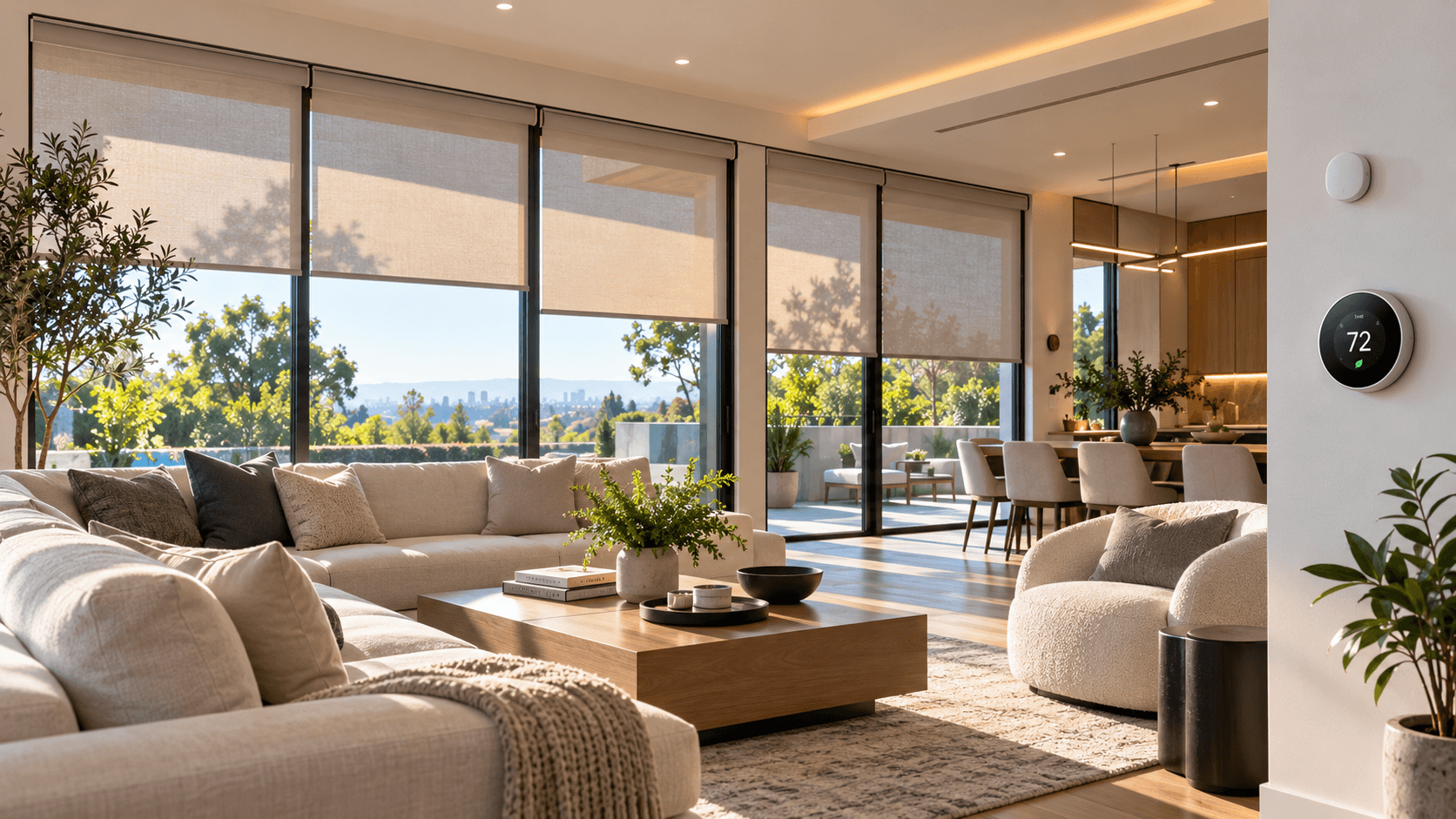
A connected home can respond to more than lighting commands and entertainment controls.
Climate systems, environmental sensors, and monitoring devices can provide information about conditions throughout a property and support appropriate automated responses.
Smart thermostats can simplify temperature management.
Humidity and environmental sensors can provide useful readings.
Leak detection and compatible automatic water shutoff equipment can add awareness and help limit damage in certain situations.
The real value comes from selecting the right equipment, placing it appropriately, and understanding what the system can reliably do.
Start With Comfort and Awareness
Environmental technology serves different purposes throughout a home.
Climate controls help maintain preferred temperatures.
Humidity monitoring can provide information about indoor conditions.
Leak sensors may detect water where it should not be present.
Air-quality monitoring equipment may provide readings for selected environmental indicators.
Different rooms may have different needs.
A bedroom, kitchen, mechanical room, bathroom, and living area do not necessarily require identical sensors or controls.
Planning begins with identifying the conditions worth monitoring and the actions customers want to take in response.
Smart Thermostats and Climate Control
Smart thermostats can provide convenient control of compatible heating and cooling equipment.
Depending on the product and installed system, they may support scheduling, remote adjustment, operating modes, and other features.
A homeowner might use different temperature settings during occupied and unoccupied periods.
Other customers may want easier access to climate settings from a wall control, application, or compatible automation platform.
However, thermostat compatibility depends on the actual heating and cooling equipment.
Not every smart thermostat works with every HVAC system.
Before installation, the equipment's control requirements and supported features should be reviewed.
Any necessary HVAC or electrical work should be performed by appropriately qualified personnel.
Placement Affects Sensor Accuracy
Environmental sensors measure conditions at their installed locations.
A sensor positioned near direct sunlight, a heat source, an air vent, or another localized influence may not represent conditions across the room.
Similarly, a humidity sensor installed in an unsuitable location may provide less useful information for its intended purpose.
Sensor placement should be based on what the device measures and what information the customer needs.
The same principle applies to thermostats and other environmental monitoring equipment.
A connected device is only as useful as the information it can provide.
Location matters.
Monitoring Humidity and Indoor Conditions
Humidity can influence comfort and certain conditions within a home.
Monitoring equipment can help customers understand changes in selected rooms or spaces.
Depending on the device, environmental monitoring may also include temperature, particulate matter, carbon dioxide, or other indicators.
It is important to understand what each sensor actually measures.
A generic air-quality label does not necessarily explain which substances or conditions a product detects.
Readings also depend on equipment quality, placement, calibration requirements, and environmental conditions.
Monitoring should provide useful information without implying that a device can detect every possible indoor air problem.
When readings indicate a concern, appropriate investigation may still be necessary.
Leak Detection and Water Monitoring
Water leaks can cause significant disruption when they go unnoticed.
Connected leak sensors may help identify water in selected areas.
Common installation locations can include areas near appliances, plumbing fixtures, water heaters, and other appropriate points where leaks may occur.
However, a sensor only monitors what its technology and placement allow it to detect.
It cannot guarantee that every leak in the property will be discovered.
The planning process should identify relevant risk areas and select sensor locations accordingly.
Notification behavior and communication reliability should also be considered.
A sensor that detects water but cannot communicate as intended may not deliver the expected benefit.
Automatic Water Shutoff
Some connected water-monitoring systems support automatic shutoff through compatible valves or controllers.
These systems may close a water supply when supported detection conditions are met.
Their behavior varies by product and installation.
Proper valve sizing, location, plumbing compatibility, controls, and access for maintenance are important.
The system must be selected and installed appropriately for the property's plumbing arrangement.
Automatic shutoff equipment should not be described as eliminating every risk of water damage.
It can provide an additional response mechanism under the conditions supported by the system.
The homeowner should also understand how the equipment operates and how to manage it when maintenance or troubleshooting is required.
Coordinate Shades, Lighting, and Climate
Sunlight affects how a room feels throughout the day.
Motorized window shades may help manage direct sunlight, glare, and privacy.
In some properties, appropriately selected shades can also contribute to managing solar heat gain.
Where supported, shade schedules and compatible climate-related controls may be coordinated.
For example, selected shades may move according to an established time schedule while the thermostat operates using preferred temperature settings.
More complex automation may be possible depending on equipment and platform capabilities.
However, integration should be chosen because it serves a practical purpose.
Not every shade movement needs to be triggered by a sensor.
The best result is often a combination of simple schedules, familiar controls, and appropriate automation.
Notifications Should Be Useful
Environmental monitoring can generate alerts or notifications.
A leak sensor may report detected water.
A thermostat or monitoring device may identify a selected condition supported by its platform.
Too many notifications can make an otherwise useful system frustrating.
The customer should understand which conditions matter, how notifications are delivered, and which users receive them.
Important alerts should be configured based on the capabilities and reliability of the installed equipment.
Customers should also understand any dependencies on networking, power, subscriptions, remote services, or applications.
A notification feature is not a substitute for appropriate inspection, maintenance, or safety measures.
Network Connectivity and Reliability
Some sensors communicate directly with supported controllers.
Others may rely on Wi-Fi, wireless hubs, gateways, or a dedicated communication platform.
Network planning should consider the actual devices and their locations.
A sensor installed near plumbing or inside an equipment space may experience different wireless conditions from equipment in an open living room.
Power requirements and battery maintenance may also affect long-term operation.
The connected system should be designed around realistic communication requirements rather than assuming all devices will always remain connected.
Where remote access or notifications are important, the supporting platform and connectivity dependencies should be understood.
Privacy and Data Access
Environmental monitoring systems may use applications, cloud services, connected accounts, and remote-access capabilities.
Customers should understand how their information is accessed and which users have permission to manage the system.
Different platforms may have different approaches to account ownership, storage, and data handling.
Privacy and security settings should be considered during configuration.
Not every environmental sensor requires the same degree of connectivity or remote access.
Choose the functions that fit the intended purpose.
Test the System and Explain Its Limits
A completed installation should include testing appropriate to the installed equipment.
That may involve checking sensor communication, thermostat controls, supported automations, notifications, and integration behavior.
For leak-detection and shutoff systems, verification must follow the equipment manufacturer's requirements and applicable installation practices.
Customers should understand the primary controls, alerts, maintenance requirements, and limitations of the system.
They should also know how to respond to a reported condition.
A well-designed monitoring system provides useful awareness without creating unrealistic expectations about what it can prevent.
Make Environmental Technology Part of the Complete Plan
Smart climate controls and sensors work best when they are selected for the property and coordinated with the systems that support them.
Placement, connectivity, equipment compatibility, monitoring goals, and customer control all matter.
Explore our smart climate and sensor solutions. Smart Climate & Sensors
Review our guide for planning a safe and well-connected smart home. Planning a Safe Smart Home
Learn about electrical and low-voltage infrastructure. Electrical & Low-Voltage Safety
Explore smart home security and privacy considerations. Smart Home Security & Privacy
Some properties may benefit from a simple smart thermostat.
Others may require several monitoring locations, leak detection, automatic shutoff, or integration with shades and automation.
Zenith Smart Spaces helps customers plan compatible climate, sensor, and monitoring systems as part of a coordinated connected environment.
The goal is better everyday comfort, useful awareness, and technology that is practical to operate and maintain.
Planning a Connected Space?
Tell Zenith what you want your technology to do, and we’ll help you determine how the systems should work together.
Related Advice

Planning & Integration
Plan Your Smart Systems as One
Connected home technology works best when the systems are planned together. Lighting, shades, security, networking, climate, entertainment, and controls should be considered as parts of the same connected environment.
Networking & Connectivity
Building a Reliable Smart Home Network
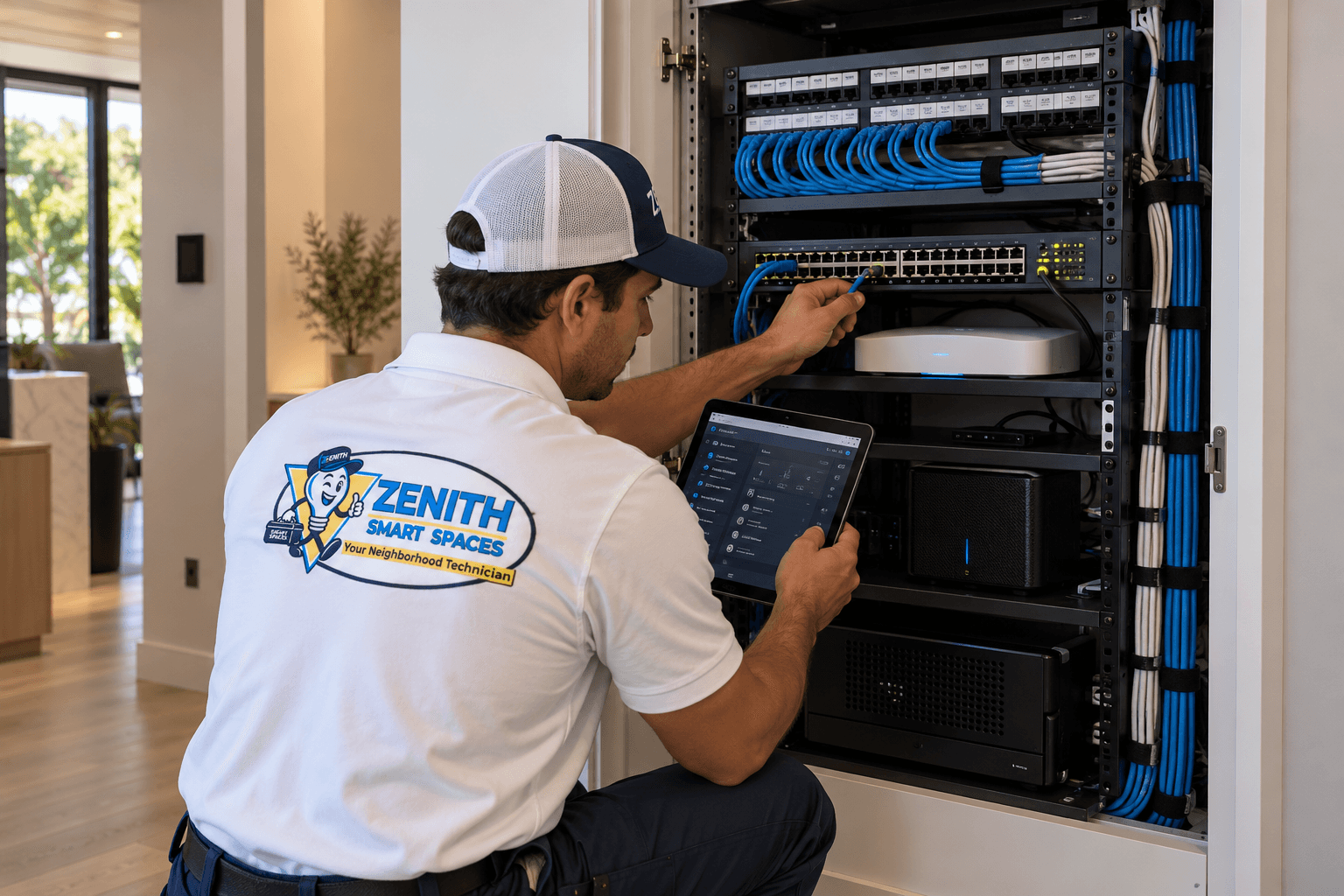
A strong network is the foundation of every connected home. Learn what to consider when planning Wi-Fi coverage, wired connections, and network hardware for automation.

Motorized Shades & Blinds
Control Heat and Glare with Motorized Shades
Motorized shades do more than add convenience — they help manage sunlight, reduce glare, protect interiors, and improve energy efficiency throughout the day.